Portland Digital Corps
18F closed and I needed to know: does community-driven service delivery actually work when you strip away the federal badge?
Why I did this
I lost my job at 18F through what I’ll call a cascade of norms-breaking chicanery. During administrative leave — the arcane term for the purgatory between having a job and no longer having one — I kept asking myself what can I do with this time that would actually help?
My big critique about design as practice has always been: what does it matter what the logo looks like in a world being upended by chaos actors who don’t care about you or your neighbors? Why should we keep designing interfaces that transform modern life without an iota of benefit being delivered to the places we live, with the people who are our neighbors?
Those are heavy questions. Most people reply “that’s not my job, we pay taxes and elect leaders to deal with that.” And it’s precisely that delegation — caring about things far away while paying less attention to how unelected committees meeting at 1pm on Monday contribute to the housing crisis in your town — that I wanted to push against.
I got the idea on a Friday. By Saturday I built the site, and we launched it on Monday. This idea was about 48 hours old as of the first blog post. Things were moving fast and I was working it out as we went.
What we actually did
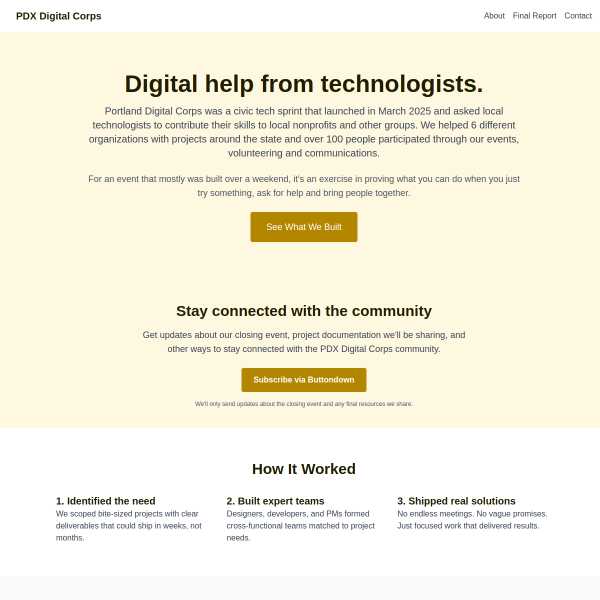
I expected maybe 20 people. Over 100 signed up. Fifty-plus designers, developers, strategists, and data people rebuilt six nonprofit websites — Built Oregon, OSU Uplift Lab, Families for Safe Streets Oregon, Cape Perpetua Collaborative, and others.
The format was deliberately different from how civic tech usually works: short-term, designer-led engagements focused on quick wins. Most projects ran 8-week sprints. No multi-month discovery. No 80-page strategy deck. Just: what does this organization need its website to do, and how fast can we get there?
I wanted to center the benefactors of this work and the doers who make it possible — not the people running the show. Having spent years rising through bureaucratic leadership, I knew that providing air cover, understanding the rules and hurdles, is what enables you to ship things. The leader’s job is making it possible for people with less context to move through and use their window of time effectively.
I said at every steering meeting: this is an experiment. It doesn’t matter how it works out. At the end of the day, we’ll have a story to tell. If we approach it that way, it takes the pressure off having to make it perfect.
What actually happened
The websites shipped. That was the expected part. What I didn’t anticipate was that it wasn’t about building tech. I was explicit about making sure all the meetups were mostly social. We did them at least once a month. People kept showing up because they wanted to work alongside people they wouldn’t normally meet.
I’ve personally met folks I wouldn’t have met otherwise. People connected to other people. Folks found jobs or something like that. I don’t want to overstate its significance, but in a world with so much terminal churn and such change, it’s super important that we connect locally to the things we can impact, to the things we can fix bit by bit.
Groups from other cities started reaching out, asking how to replicate it. That told me something: the demand for collaborative, low-ego service work vastly exceeds the supply of places to do it. Most people who care about public service don’t have a path to it. They just need someone to hold the door open.
What it taught me
I don’t have the illusion that building a website is going to change the world, but I do think it can make something better. And all the connection pieces that go into it — the community, the trust, the learning — made this worthwhile.
The overhead I assumed was necessary — procurement, approvals, formal partnerships, a fully baked plan — turned out to be optional. No budget. No office. No institutional backing. Six websites shipped.
Find folks your community already has who are doing things you can help with. You don’t have to start your own thing. But if you do — don’t think about it too much.
The volunteers from the first cohort asked when the next one starts. That’s the only metric that matters.
More at digitalcorpspdx.org